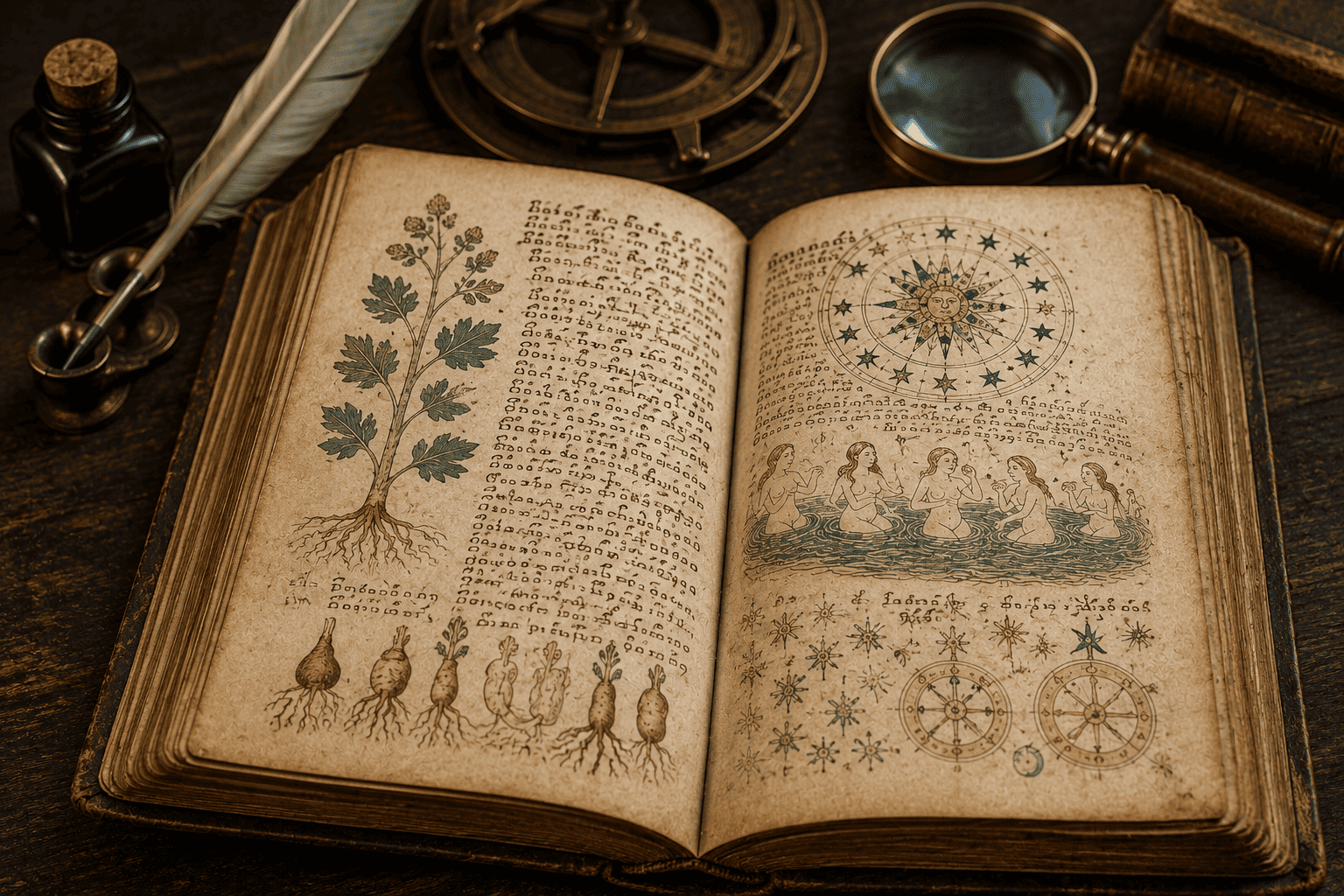
Imagine finding a book that no one in the world can read.
Not because it is damaged or incomplete—but because it is written in a strange language that nobody understands. Its pages are filled with unusual plants, mysterious symbols, and strange drawings of people and stars. For more than 100 years, experts, scientists, and codebreakers have tried to solve it. Yet the mystery remains.
This is the story of the Voynich Manuscript, one of the world’s most puzzling books.
What Is the Voynich Manuscript?
The Voynich Manuscript is an old handwritten book, also called a codex, believed to have been created in the early 15th century (around 1404–1438).
It is famous because its writing has never been understood.
The manuscript contains about 240 pages made from vellum, a special writing material prepared from animal skin. The text is written by hand using dark ink, and many pages contain colorful illustrations.
What makes it unusual is that the book is written in a script unlike any known language. This unknown writing system is often called “Voynichese.”
Even after decades of study, nobody knows what it says.
How Was It Discovered?
Although the book is very old, it became famous only in 1912.
A rare book dealer named Wilfrid Voynich found it in a Jesuit college near Rome. He bought the manuscript and brought it to public attention.
Because of him, the book became known as the “Voynich Manuscript.”
Inside the book, Voynich found a letter from the 1600s. This letter was written by a scholar named Johannes Marcus Marci to Athanasius Kircher. Marci said the manuscript might have once belonged to Rudolf II, who reportedly bought it for a large amount of money.
This gave historians their first clues about its journey through time.
How Old Is It?
For many years, people debated whether the manuscript was real or fake.
In 2009, scientists used radiocarbon dating to test the vellum. The results showed it was made between 1404 and 1438.
This proved the manuscript is genuinely medieval.
However, the age of the pages does not necessarily tell us when the text was written. Still, most researchers believe the writing is from the same time period.
What Does It Look Like?
The manuscript is divided into different sections based on its illustrations. Since no one can read the text, researchers classify the sections by their images.
1. Herbal Section
The largest part of the manuscript contains drawings of plants.
At first, these seem like pages from a medieval medicine book. But there is a problem: most of the plants do not match any real species.
Some appear to be mixtures of different plants.
This has led to theories that they may be imaginary, symbolic, or poorly drawn versions of real plants.
2. Astronomical Section
Another part contains stars, suns, moons, and circular diagrams.
These may represent astronomy or astrology.
Some pages show zodiac symbols like Aries, Taurus, and Pisces, suggesting the author may have been interested in horoscopes.
3. Biological Section
This is one of the strangest parts.
It shows many small female figures, often bathing in green liquid or connected by tubes.
Some researchers think this might represent the human body, medicine, or fertility. But nobody knows for sure.
4. Cosmological Section
This section contains fold-out pages with complex diagrams.
These may represent maps, worlds, or some kind of spiritual ideas.
One large circular drawing has puzzled researchers for years.
5. Pharmaceutical Section
This section includes drawings of jars, roots, and plant parts.
It looks similar to old medical guides used to prepare medicines.
6. Recipe Section
The final part contains short paragraphs marked with star-like symbols.
Many believe these may be recipes, instructions, or notes.
What Language Is It Written In?
This is the biggest mystery.
The writing system contains around 20–30 common symbols, with many rare ones. The text flows from left to right, much like English.
Interestingly, the words follow patterns found in real languages:
- Some words repeat often.
- Some words appear only in certain sections.
- The word lengths follow natural patterns.
This makes the manuscript seem less random than nonsense. Yet no one has matched it to any known language. This raises a huge question: Is it a real language, a code, or something else?
Theories About the Manuscript
Over the years, many theories have been suggested.
Theory 1: It Is a Secret Code
Some believe the manuscript hides a coded message. In history, people often used ciphers to protect important information.
This theory became popular because famous codebreakers studied it. During World War II, expert cryptographers examined the manuscript, but none could crack it. That made the mystery even deeper.
Theory 2: It Is a Lost Language
Another theory says it could be a real language that disappeared. Perhaps it belonged to a small community or secret group. If so, there may be no surviving examples to compare it with.
Theory 3: It Is a Hoax
Some people think the manuscript is a clever fake.
Maybe the author created meaningless symbols to fool wealthy buyers. This idea seems possible—but creating 240 pages of consistent nonsense would have required enormous effort. Also, the patterns in the text seem too organized for random writing.
Theory 4: It Is Artificial or Invented
Some researchers think the author invented a new language. This could have been for secrecy, experimentation, or personal use. This idea is interesting because the text has structure but remains unrecognized.
Can Artificial Intelligence Solve It?
In recent years, AI has been used to study the manuscript. Computers can examine patterns much faster than humans.
Some AI studies suggest the text behaves like a natural language. Others argue it could be generated by a simple rule system. But so far, AI has not solved it.
This shows how difficult the mystery is. Even modern technology struggles with it.
Why Does It Fascinate People?
The Voynich Manuscript is fascinating because it touches many human curiosities:
- Secret knowledge
- Lost civilizations
- Ancient science
- Unsolved mysteries
- Hidden history
It feels like a puzzle from another world. Unlike many historical mysteries, the manuscript still exists. Anyone can study its pages and try to solve it. This makes people feel that the answer might still be waiting to be discovered.
Where Is It Now?
Today, the Voynich Manuscript is kept at Yale University in the Beinecke Rare Book & Manuscript Library.
It is carefully preserved because of its age and importance.
Digital copies are available online, allowing people around the world to study it. This has opened the mystery to historians, linguists, and curious readers everywhere.
Will It Ever Be Solved?
That is the big question.
Some experts believe it will eventually be decoded. Others think it may remain a mystery forever.
If the manuscript is a real language or code, solving it could reveal lost knowledge about medicine, astronomy, or medieval life. But if it is a hoax, it may simply be one of history’s greatest tricks.
Either way, the Voynich Manuscript has already achieved something remarkable: It has kept humanity guessing for centuries.
Conclusion
The Voynich Manuscript is more than just an old book. It is one of history’s greatest unsolved mysteries.
Its strange language, unusual drawings, and unknown purpose continue to challenge experts. Despite modern science, cryptography, and artificial intelligence, no one has fully unlocked its secrets.
Perhaps one day, someone will finally understand it.
Until then, the Voynich Manuscript remains a symbol of mystery—proof that even in our modern world, some secrets of the past still refuse to be explained.